

The Bird, the Branch, and the Myth of Confidence
How skills, experience, and environment shape what we call “confidence”—in birds, dogs, and ourselves

I’ve been surrounded by birds my whole life without paying them much attention, and then one day, I seemed to wake up transfixed by them. It’s unclear if I walked through some portal in a dream or if conditions in my life all of the sudden lined up to make watching birds maximally reinforcing. One of those seems far more likely, but I am unwilling to rule out the other.
A Quote, a Songbird, and a Broken Branch
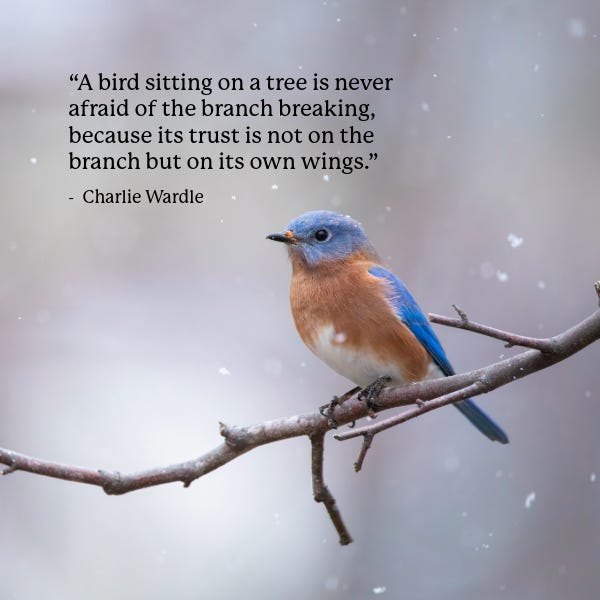
I was scrolling on Instagram the other day, when a photo of a bird demanded that my thumbs stop. The picture of the perfect little songbird had a quote written over it:
“A bird sitting on a tree is never afraid of the branch breaking, because its trust is not on the branch but on its own wings.”
― Charlie Wardle
I am certain this wasn’t the first time I’d come across this quote, but it landed differently on this day. Probably partly because I feel like the life branch I was perched on just broke and partly because I am now deeply nerdy about behavior. I know overthinking gets a bad wrap, but sometimes I think it’s fun to overthink the shit out of something – like a simple quote over a photo of a songbird. Is it possible, in this endeavour, to glean something useful about how to support our dogs and build their confidence?
I think so, but let’s see!
When I typed the quote into Google to make sure what I had read on the Instagram image was accurate, I discovered that the quote actually has one more line to it:
“Always believe in yourself.”
What Does It Mean to “Believe in Yourself,” Anyway?
But how does one come to believe in themselves (and what does that even look like)?
I’d argue through experience. Through learning.
For the sake of our overthinking exercise, let’s imagine a baby bird who definitively has wings but has not yet learned to use them to fly (yes, birds must learn to fly) and is sitting on a branch. The branch snaps and the bird tumbles to the ground (uninjured but not thrilled). Hmmm. The same bird ends up on another branch (don’t ask me about how this imaginary bird got up there again) that also somehow snaps. The young bird falls again. There’s a decent chance this bird is going to start avoiding branches and feeling uncomfortable when they find themselves on one. Why? The bird didn’t yet have the skills needed to successfully navigate a branch breaking when it broke.
Now you put a bird who has a boat load of flight experience on a branch that snaps, and while it may startle them, they’ll simply start to fly. They have the skills to navigate that situation.
Confidence Is Built Where Skills Meet Environment
Trust comes from having the skills needed to navigate situations and successfully access reinforcers. Big skill repertoires help with this. But the environment is not a non-factor. If you put an individual in environments where they don’t have the skills they need to access reinforcers and avoid punishers, they’re not going to feel great.
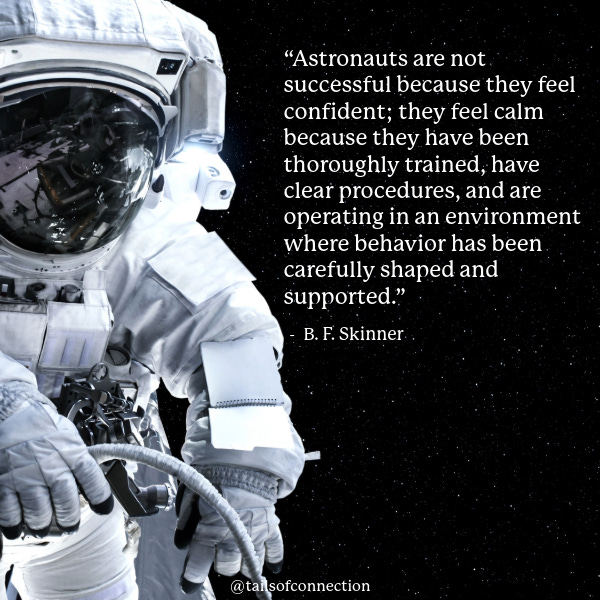
Anytime I think about confidence, I think about this quote from B.F. Skinner:
“Astronauts are not successful because they feel confident; they feel calm because they have been thoroughly trained, have clear procedures, and are operating in an environment where behavior has been carefully shaped and supported.”
Astronauts have to operate in some objectively risky environments, but the way they feel and behave in tough situations stems from having experience in environments that have been carefully arranged. Their behavior – including their emotional behavior – has been shaped by very thoughtful antecedent arrangements.
If you were teaching a bird to fly, you would absolutely make sure you had a stable branch/perch for the bird to launch from. Often to build the skills and feelings we call “confidence,” we have to pay a lot of attention to the literal and metaphorical branch (aka the environment). We need environments that will gradually shape behavior and allow a learner to successfully access reinforcers. Once they have those skills, they’re more likely to remain comfortable even when the environment presents a challenge.
Trust and confidence comes from mastery. It comes from having skills. It comes from experience.
Why Some Can Feel Calm Doing Risky Things
I don’t know if you’ve watched any of the winter Olympics, but I recently caught a little of the snowboarding Big Air event. It’s the one where they go super fast down a big hill and then up a huge ramp and are launched into the ether where they twist and flip and hopefully land rightside up. I always chuckle at how calm all of these athletes look. Why are they so calm doing something that could go so horrible wrong if you land a few degrees off? Is it simply because they are confident and trust their abilities? But why do they trust their abilities?
I don’t know exactly how these athletes train, but I feel certain that they don’t start out on the jumps we see in the Olympics. They likely first build skills on gentle hills and gradually build up to steeper hills. They likely start on jumps that only cause them to leave the solid ground for a second or two. They don’t magically have the confidence to do these wild Olympic jumps simply because they decided they could. They slowly built skills in environments that were suitable to their skill level. They mastered skills in those contexts and then progressed. The feelings of confidence arose from that mastery.
Oh, and by the way, the verbal thinking behavior that we’d label as “believing in themselves” was learned along the way too!
What This Means for Our Dogs
So how does any of this relate to dogs?
